Animals
|
Otus – Eastern Screech Owl (Megascops asio) – a small owl, ranging from 6.3 to 9.8 inches as adults, with either rusty or dark gray intricately patterned plumage and streaking on the underparts. Did You Know? The 1992 comedy My Cousin Vinny featured a scene where the owl’s screech kept the movie characters awake – however, the movie audio didn’t accurately portray the owl’s screech.

Otus was found in May 2009 as a juvenile in Wilkes County and unable to fly. Upon examination at the Carolina Raptor Center, he was found to have a fractured left humerus that did not heal properly. Because of his injury, he cannot fly to catch his prey or escape from a predator. The CRC staff selected Otus to be placed with Piedmont Wildlife Center because they felt his temperament would make him a good education bird. He has proven to be just that! Otus is attending events and education programs and is available for booking at your next event, school or group program.
|
BooRadley – Red-tailed Hawk (Buteo jamaicensis)– one of the largest members of the genus Buteo in North America, typically weighing from 1.5 to 3.5 pounds and measuring 18 to 26 inches in length, with a wingspan from 43 to 57 inches. Did You Know? In Native Americanculture its feathers are considered sacred by some tribes and used in religious ceremonies.
BooRadley was found in July 2009 in Gaston County with numerous injuries after he was transferred from an emergency vet clinic. He had a chip out of its upper beak, he had major feather damage to his right wing and tail and will not fly. He has no chance of survival in the wild if he cannot fly to catch prey or to escape from predators. He has made wonderful progress over the last 6 months and has molted in new wing feathers and tail feathers! He is still unable to fly but is much more mobile in his habitat and has been working very well on the glove with our volunteer raptor group. He is making regular public appearances at events and education programs.
|
|
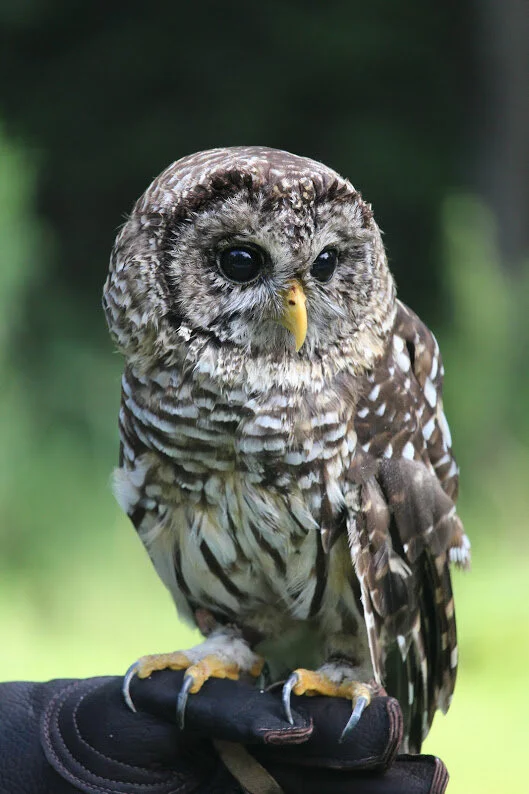
Athena – Barred Owl (Strix varia) -a medium sized owl measuring 16-25 inches in length with an average 38-50 inch wingspan. Did You Know? Barred owls are vocal birds and are notably heard singing “Who cook, who cooks, who cooks for you.” They are also commonly known as Hoot owls.
Athena, the barred owl, was found in Lincoln County in December of 2009 with major feather damage, a fractured pelvis, two fractured bones in her right wing and blind in her right eye. Her pelvic and wing injuries were repaired surgically by the Carolina Raptor Center in hopes of returning her back to the wild. The wing injuries healed but not well enough for Athena to be able to hunt and survive in the wild. After many months of rehabilitation, flight exercises and physical therapy the staff at CRC decided she was non-releaseable. Athena is an adult bird of unknown age and most likely a female because of her weight and size. She arrived at PWC on February 24, 2011 along with another barred owl named Lily.
Athena is a favorite among many of our raptor care and handling volunteers!
|
|
|
Kellogg – Eastern Corn Snake (Elaphe guttata) -
Kellogg came to us as a two-month old baby in 2007 from the NC Museum of Natural Sciences. The Museum veterinarian had bred a number of corn snakes and donated Kellogg to us.
He is a favorite of the children (and some adults) who attend our programs.
|
|
|
Eastern Kingsnake (Name the King Snake! – see our blog for instructions)
(Lampropeltis getula getula) – The Kingsnake was donated to us in 2011. She was previously being used as an educational animal, but was no longer needed by her owner. The kingsnake’s owner donated her to Piedmont Wildlife Center and she has been a great addition after a little bit of socialization!
Kingsnakes are resistant to venom and they will even eat venomous snakes that are found in your yard, such as copperheads, cottonmouths, and rattlesnakes!
Kingsnakes also frequently rattle their tails to mimic rattlesnakes. This is one way they defend themselves from unwelcome predators!
|
Miracle– Silky Ringneck Dove – The silky dove is one of many domesticated doves or pigeons, bred for particular characteristics. Miracle is a white dove with “frizzled” ends on his feathers, causing the dove not to be able to gain lift and fly. He flutters to the ground whenever he tries to fly.Did You Know? Miracle was born in a library when the librarian that took care of his parents didn’t notice a third egg laid in the cage and only removed the normal two eggs laid by the parents each spring. Birds in the wild will lay multiple eggs and double clutches of eggs to ensure that their offspring have a better chance of survival.
Miracle was donated to us in 2009 by “Birdman” Dave Gulick when he moved from the area and couldn’t take Miracle with him. Miracle is very friendly and likes to be held by the children attending our programs.
|
| Chickens (Gallus gallus domesticus) – The chickens joined us during the summer of 2011. We got them from the Pittsboro feed store, by one of our extraordinary CIT, Colin. They are a wonderful addition to Piedmont Wildlife Center providing us with eggs and entertainment. Our chickens are free-range and enjoy a variety of bugs and plants while roaming around the park. They are becoming well-socialized and help children get back to the basics about where our food comes from.
Fo’ Shizzle (Brabanter)
Mocha (Ameracauna)

Joanna (Unknown)
|
Walter – Bearded Dragon Lizard (Pogona vitticeps) – Our beloved bearded dragon, Walter, passed away on Wednesday, December 7, 2011, at the ripe age of 14. A captive bearded dragons’s life expectancy is 10-12 years. She most likely passed away due to kidney failure, the most common cause of death in captive dragons. She was a wonderful educational animal with her docile temperament and ease of handling. In the summer, she loved being outside and eating her salad prepared by our wonderful animal caretakers.
Walter came to us in 2007 from the NC Museum of Natural Sciences in Raleigh when she was taken off display because of her sedentary behavior. Someone had found her wandering around a yard in Raleigh, after she was “released” by her owner, and was then taken to the Museum of Natural Sciences.
She will be dearly missed by all those who knew her.
|
Give us a call at 489-0900 if you would like to have any of our animals visit your group or school.