In Memory: Scout the Eastern Gray Squirrel

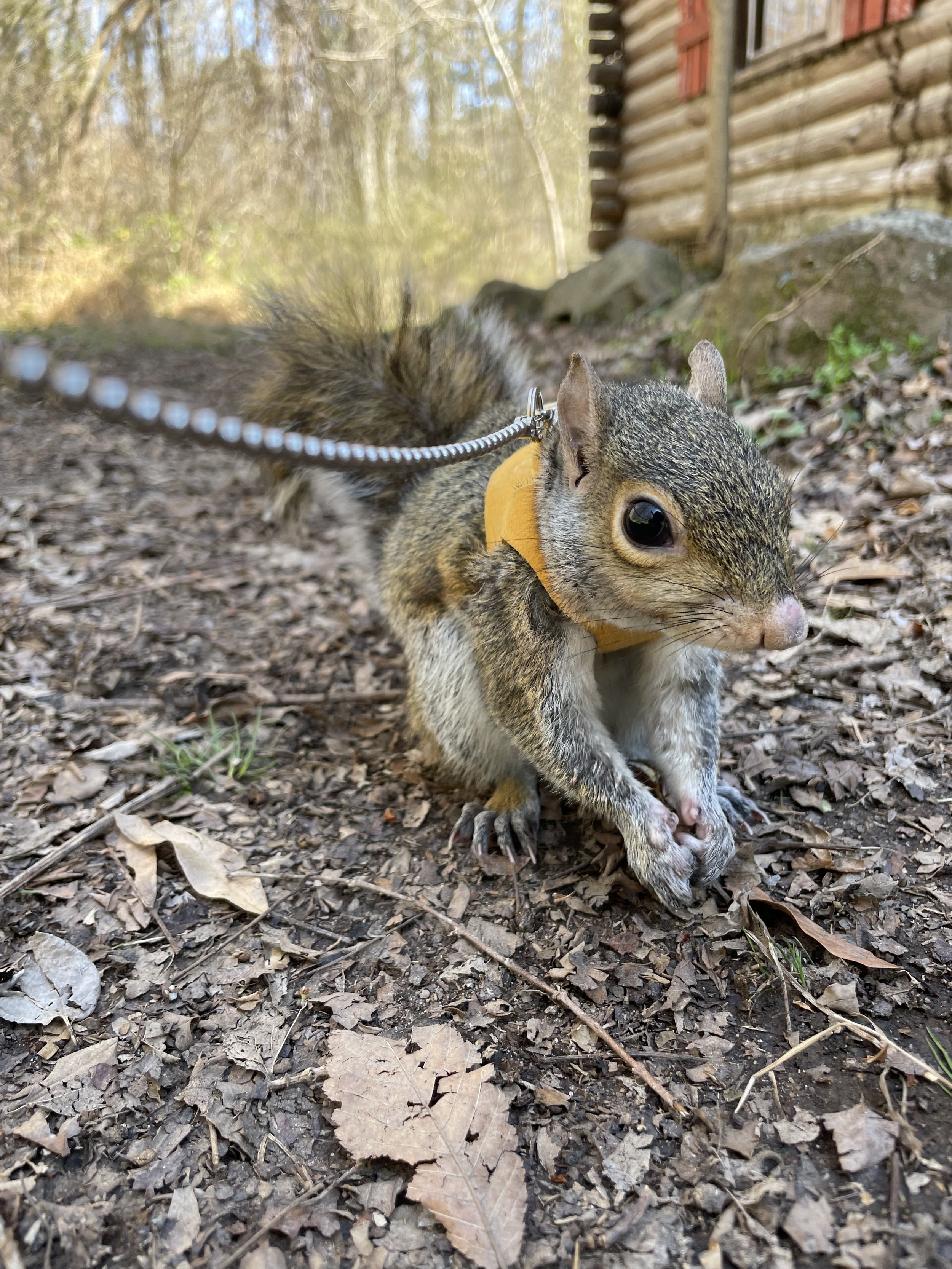
Scout, an eastern gray squirrel, lays sleeping in the grass with his eyes closed. He is wearing a yellow harness attached to a leash.

It is with a heavy heart that we announce that Scout, the eastern gray squirrel, unexpectedly passed away this Sunday, June 12th. He had only been with PWC since May 2021, but he quickly earned a special place in our hearts with his silly antics, boundless energy, and unending love of snacks.

In early 2021, Scout’s rescuer found him acting abnormally at the base of a tree. Scout was brought to Our Wild Neighbors, where it was discovered he was blind. Blindness in squirrels is often caused by head trauma due to falling from trees during severe weather conditions. He would not have survived in the wild, so he was brought to PWC to educate people about the important role squirrels play in nature.

Despite his blindness and other neurological abnormalities, Scout led an exciting life at PWC. His enclosure was filled with hammocks, sticks, and platforms to explore, and he enjoyed regular walks to soak up the sunshine. He never failed to make visitors and staff smile, whether at a birthday program, a classroom presentation, or a visit with kids at our camps. He even had the honor of having a special coffee blend at Gray Squirrel Coffee Co. named after him!

While we wish he could have spent more time with us, we understand that many of the animals in our care are with us because they have permanent injuries. It is our job to ensure that whatever amount of time they have with us is full of love, care, and purpose. We’re so grateful to have had the opportunity to care for Scout and share him with the world.

If you had the pleasure of meeting Scout over the last year, we would love it if you could share any memories or photos with us. We hope our favorite squirrel brought as much joy to you as he did to us.

Special thanks to Scout’s sponsors: Raffaela A, XJ, Jeff and Jessica H, and The Squirrel Whisperers.

If you would like to make a gift in Scout’s memory, please visit our donation page.

Community Spotlight: Kaitlin Saxton

Running a box turtle population study, managing three conservation interns, and ensuring the health and safety of twenty-three Ambassador Animals: all in a day's work for Kaitlin Saxton, PWC's new Research & Husbandry Coordinator!

Kaitlin grew up in South Carolina and moved to NC for grad school, where she earned her Master's in Environmental Management from Duke University. Her research interests include wildlife surveys and population monitoring. In her spare time, Kaitlin also enjoys hiking, camping, cooking, and caring for her pet rats and tarantula.

"Three words to describe Kaitlin are innovative, tenacious, and determined," says Noelle Dalhouse, Conservation Coordinator. Kaitlin has only been at PWC since April, but she's already become an invaluable part of our team. From getting our summer conservation interns involved in Caterpillars Count to crafting a custom feeding station to keep ants out of Otus's food dish, Kaitlin has hit the ground running with creative ideas to expand and improve PWC's conservation work!

Noelle says it best: "We're so excited to have Kaitlin on our team! In the short time that she's been here, we've already seen her creative and innovative ideas and can't wait to see how she continues to improve the Conservation Team."

Welcome aboard, Kaitlin! We're so happy you're here.

5 Black Naturalists You Should Know

Black Birders Week 2022 is May 29th to June 4th! This weeklong celebration was started in 2020 by the BlackAFinSTEM Collective to highlight Black nature enthusiasts, increase the visibility of Black birders, and celebrate diversity in the great outdoors.

In honor of Black Birders Week and PWC’s core value of inclusivity, we asked our staff to share the names of famous Black birders, ornithologists, and naturalists they want everyone to know. Here are 5 of our favorites:

1. Corina Newsome, M.Sc.

Atlanta-based ornithologist and science communicator Corina Newsome has gained a huge following on social media, and with good reason! In addition to her environmental justice advocacy, her experience working with birds at the Nashville Zoo, and her graduate research on threats facing the seaside sparrow, Corina is one of the driving forces behind Black Birders Week. She co-founded the annual celebration in 2020 with herpetologist Earyn McGee, and was soon featured in National Geographic, Scientific American, and other media for her groundbreaking work.

If you don’t already, you can follow Corina (@hood_naturalist) on Instagram and Twitter.

2. Alexis Nikole Nelson

“Happy snacking - don’t die!” With more than 3.7 million followers on TikTok, Alexis Nikole Nelson has done more than nearly anyone else on the Internet to introduce young people to the art of foraging. She uses her videos to share her knowledge of wild edible plants, and also addresses social issues like the role of foraging in African-American history.

You can keep up with Alexis’s adventures on Tiktok (@alexisnikole), as well as on Facebook and Instagram (@blackforager).

3. J. Drew Lanham, PhD

Dr. J. Drew Lanham is an Alumni Distinguished Professor of wildlife at Clemson University in South Carolina, where he researches songbird ecology and is recognized as a national leader in conservation. He is also an award-winning author of essays and poems, which take inspiration from his experience as a birder, naturalist, and hunter-conservationist.

You can follow Dr. Lanham on Instagram and Twitter (@wildandincolor). His memoir The Home Place: Memoirs of a Colored Man’s Love Affair with Nature (2017 Southern Book Prize winner) is a must-read for fans of thoughtful nature writing!

4. Deja Perkins, M.Sc.

If you’re active in the Triangle’s birding community, you may recognize Deja Perkins! Deja is a Raleigh-based urban ecologist and science communicator who is passionate about showing people that nature exists in cities, too. In addition to her research on urban birds, she has worked with Triangle Bird Count, Duke Gardens, and other organizations to help people better understand the wildlife around them. She was also a co-organizer of the first Black Birders Week, and is putting North Carolina on the celebration’s map by leading in-person bird walks this week in Raleigh and Elizabethtown!

Keep up with Deja’s work on Twitter and Instagram (@naturallywild__).

5. Rodney Stotts

Rodney Stotts made headlines this spring when his memoir Bird Brother: A Falconer’s Journey and the Healing Power of Wildlife was published, but his journey to becoming a master falconer began in the late 1980s, when visiting the bald eagles at the Smithsonian National Zoo gave him comfort in what was otherwise a difficult life of poverty and violence. He was eventually able to turn his life around through falconry and conservation, and is currently building a raptor sanctuary and falconry center in rural Virginia so he can pass on the gift of wildlife to others.

You can follow him on Twitter (@RodneyStotts1) and Instagram (@rodney_birdbrother), or learn more by watching the documentary The Falconer.


Learn more about Black Birders Week at from the BlackAFinSTEM Collective, Audubon Society, and Smithsonian. Then view this week’s schedule of online events and activities to get involved!

Join us for our Summer Solstice Reunion, June 25!

Calling all past and present campers, staff, volunteers, CITs, interns, board members, and donors. We're throwing a party - and YOU are invited!

Join us on Saturday, June 25th from 4:30-7:30 PM at Leigh Farm Park for our inaugural Summer Solstice Reunion. Reunite with old friends, make new ones, and celebrate the start of summer as we eat good food, play camp games, and share our love of nature connection.

This is a potluck celebration, so bring your favorite snack, side dish, or dessert! We'll provide hamburgers and hotdogs (including vegan options) and grill them for everyone to enjoy.

Please RSVP below to let us know if you'll attend. Friends, family members, children, and partners welcome!

This event is FREE to all past and present PWC community members, though we will gratefully accept donations. In case of rain or other inclement weather, we will gather on Sunday, June 26th instead. We can't wait to see you!

RSVP

5 ways to help box turtles this World Turtle Day

May 23rd is World Turtle Day! We're all about eastern box turtles here at Piedmont Wildlife Center. If you are too, here are five ways you can help this declining species:


#1: Donate to box turtle conservation

Support our box turtle conservation and research efforts by donating at GlobalGiving. Your recurring or one-time donation helps us keep our radio telemetry equipment in tip-top shape, get more people involved in our Triangle Turtle Trekkers citizen science project, and share our research findings with other members of the Box Turtle Connection and beyond.


#2: Don’t purchase a box turtle as a pet

Make a commitment not to buy box turtles as pets or remove them from the wild. The pet trade is a major contributor to eastern box turtles’ status as a species in decline. Not only is it illegal to take box turtles from the wild in NC, but it causes stress and also removes individual turtles from the breeding pool - which means there will be fewer wild turtles in the future.


#3: Become a citizen scientist

Help monitor box turtle populations in NC as a citizen scientist through PWC’s Triangle Turtle Trekkers. Spot a box turtle in your yard, favorite park, or place of business? Snap a photo and upload your sighting to turtletrekkers.org!


#4: Help turtles cross the street safely

If you see a box turtle trying to cross the road (and it's safe to do so), help them across in the direction they're headed. Please don’t put them back on the side of the road they came from, or relocate them to another location. Box turtles have a strong homing instinct and will turn right back around! Don’t worry if there are no ponds, lakes, or streams nearby - box turtles are terrestrial (land-dwelling) turtles and don’t live in water.


#5: Build wildlife habitat in your yard

If you have a yard, consider turning part of it into wildlife habitat for box turtles and other native animals! Make a plan to grow native plants and establish brush piles to encourage box turtles to live in your garden.