Plant Magic: White Clovers

White Clover, Trifolium repens. Photo by Karen McCall.

Join our Executive Director, Karen McCall, as she journeys outside amid the spring rains to bring us another installment in our Plant Magic series. In this installment, we explore some classic beauties and learn how to incorporate them into our diet and yard! 

Today, I bring you the white clover, Trifolium repens, that often grows in our yards. This low-growing plant usually has a leaf with three leaflets and looks like some creature took a white pen and scribbled lines forming an arrow across the middle of each leaflet pointing towards its tip. The flowers are white, sometimes with a hint of pink. They grow in patches through spreading roots across the ground and through seeds created by pollination from bees and butterflies.

Hopefully, many of you have experienced the magic of searching for and finding a four- or more-leafed clover (again, the number refers to the leaflet)! This discovery brings feelings of success and joy, and you cannot help but shout out “I found a four-leafed clover!” and smile. Legend has it that this find will bring you good luck. If nothing else, it will brighten your day and mood - what great medicine!

While white clover is often perceived as a nuisance in grass, it plays a crucial role in our ecosystem. It enriches nitrogen-poor soil by extracting nitrogen from the air and releasing it into the ground to fertilize surrounding plants. White clovers are also an excellent nectar source for bees and butterflies. Voles, rabbits, groundhogs, and squirrels eat them, among others, and it serves as the host plant for caterpillars of the painted lady and clouded sulphur butterflies. 

So next time you see them pop up in your yard, I hope you look at them in a new light and stop to revel in their magic as you search for the elusive four-leafed one!

If you’re interested in welcoming native plants into your garden, consider supporting both your local ecosystem and Piedmont Wildlife Center by buying plants from Garden for Wildlife by National Wildlife Federation! 15% of each purchase you make through our referral link will be donated directly to Piedmont Wildlife Center to help us connect more people with nature.

Disclaimer: White Clover is NOT a native plant. It is a naturalized exotic that is non-invasive.

White Clover, Trifolium repens. Photo by Karen McCall.

Plant Magic: PawPaws and Bluets

Common Bluet, Houstonia caerulea. Photo by Karen McCall.

Join our Executive Director, Karen McCall, as she journeys outside amid the varying hues of green foliage to bring us another installment in our Plant Magic series. In this installment, we explore paw-paws and bluets!


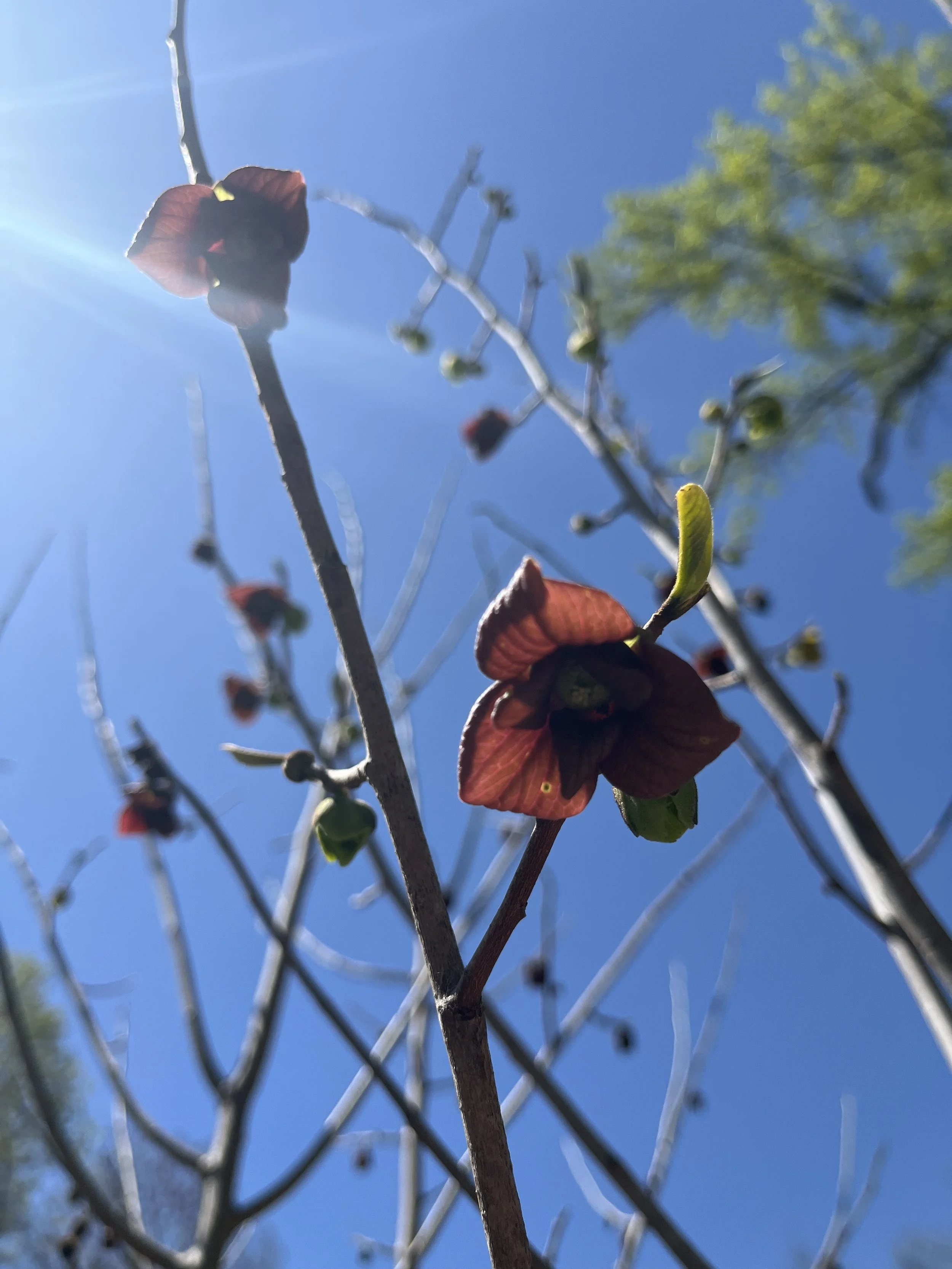
Growing up I remember singing “Way down yonder in the paw-paw patch…pickin’ up paw-paws, putin’ ‘em in her pockets…” It made me laugh and was also a mystery as I had seen the trees but never the fruits until much later in life. The paw-paw tree, Asimina trilob, is a southeastern U.S. native understory tree, found in bottoms of ravines, low areas that tend to be wet, and creeksides. The trees can multiply through their root system, but won’t produce fruit without a different strain nearby for cross-pollination of their flower, thus forming the fruit. 

The kidney-shaped fruits (the largest edible fruit native to the United States) start out green, then turn yellow to black when they ripen in the fall. Rich in minerals like copper, iron, magnesium, manganese, and iron, they are also a great source of vitamin C, potassium, protein and much more! Not a fan of the banana, I was never eager to try the fruit as that is the flavor people would liken it to. In recent years, though, I have been as adventurous and open-minded as possible, biting into a few paw-paws that have been offered to me. The last was similar in flavor to a mango and quite creamy, like banana pudding! For more in depth information, Kentucky State University has a full-time pawpaw research program. Visit,  https://perma.cc/NZT3-GCWY for more information. 

Another quite different spring flower that always excites me and lightens my step is the common bluet, Houstonia caerulea. This delicate native plant appears across our state and has a little 4 petaled flower with a yellow center. Sometimes many appear in an area looking like a carpet covering the spring ground, almost seeming to be suspended just above moss or leaf litter. It serves as a pollinator plant for bees, butterflies and others, and as a host plant for the Spotted Thyris moth, thyris maculata.  

If you’re interested in welcoming native plants like these into your own garden, consider supporting both your local ecosystem and Piedmont Wildlife Center by buying plants from Garden for Wildlife by National Wildlife Federation! 15% of each purchase you make through our referral link will be donated directly to Piedmont Wildlife Center to help us connect more people with nature.

Paw-Paw Tree, Asimina trilob. Photo by Karen McCall.

Plant Magic: flowering dogwood and purple violet

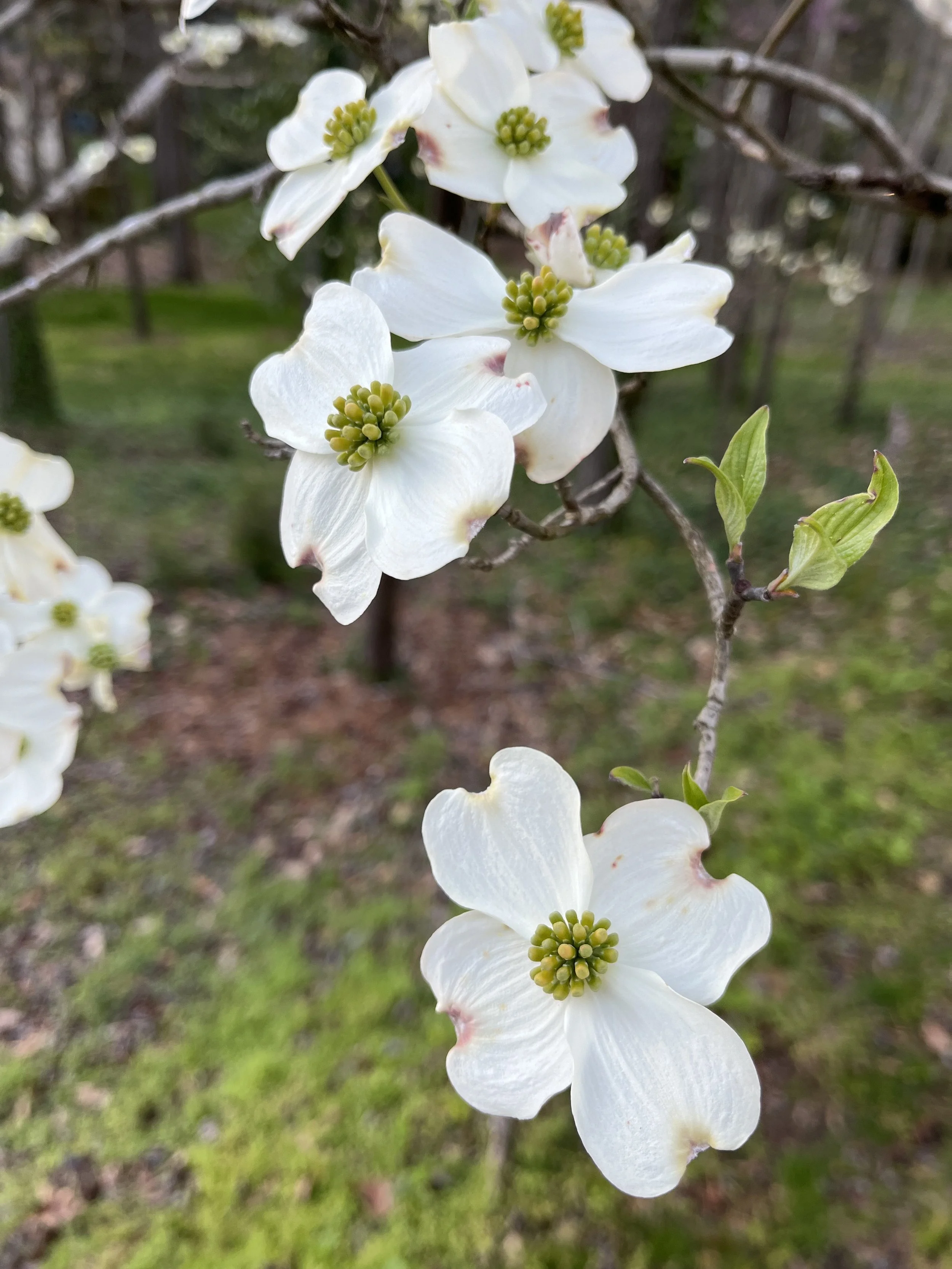
Flowering dogwood, Cornus florida. Photo by Karen McCall.

Join our Executive Director, Karen McCall, as she journeys outside amid the spring rains to bring us another installment in our Plant Magic series. In this installment, we explore some classic beauties and learn how we can incorporate them into our diet and our yard!


As we begin the month of April, my eyes have been drawn to a small tree whose flowers dance with moonlight and sun in the understory of the woods near me. Scanning the ground, I am greeted by a lovely burst of color from the hues of purple flowers in my yard. 

The flowering dogwoods, Cornus florida, North Carolina’s state flower, consists of four white “petals”. These are actually bracts (a modified leaf that protects the flower within the bud) surrounding a cluster of not just one, but many very small greenish flowers in the center! The bark of the tree is corky and dark colored. For many, this tree is a symbol of spring, but also has been an important symbol in many cultures and religions. The twigs were chewed on to brush teeth, and sources say different parts of the plant were used medicinally as an antimalarial, pain-reducer, and anti-inflammatory to name a few.

As you walk along roadsides, old fields, or forest edges, you will hopefully come across our friends, the violas, or violets as they are often called.The purple violet, Viola papillionacea or Viola sororia, has smooth heart-shaped leaves and purple (sometimes called blue) petals with a lighter “eye” or center with a whitish yellow hue. The flowers can be eaten making a beautiful accent to salad, or candied and put on top of desserts or decorations for the plate. Not all violas are edible so before you pick any plant, always make sure to identify the plants by at least 3 characteristics; if on someone’s property, ask; make sure they are not growing on roadsides or places where insecticides or pesticides have been used and only take 1 for every 10 you see. Be thankful for the plant, if you decide to try them! 


April is National Garden Month and Native Plant Month! If you’re interested in welcoming native plants like these into your own garden, consider supporting both your local ecosystem and Piedmont Wildlife Center by buying plants from Garden for Wildlife by National Wildlife Federation! 15% of each purchase you make through our referral link will be donated directly to Piedmont Wildlife Center to help us connect more people with nature.

Purple violet, Viola papillionacea. Photo by Karen McCall.

Plant Magic: Eastern Redbud and Rue Anemone

Rue anemone, Anemonella thalictroides. Photo by Karen McCall.

Spring is coming to the North Carolina Piedmont - which means the return of trout lily, spring-beauty, and other spring ephemerals! In this series by Executive Director Karen McCall, we explore the wonder of spring wildflowers and celebrate the launch of our new native plant fundraiser through Garden for Wildlife.

Happy first day of spring! In honor of the vernal (spring) equinox, which occurs at 11:06 PM tonight, I bring you my favorite tree and a delicate flower to balance it out.

A good identifier of my tree in winter are the subtle zig-zag dark-colored branches. In early spring, beautiful reddish or magenta buds appear before the leaves, covering its branches in color. Smell the air near one of these trees, or taste one of the edible buds (which are better before the flowers open). Its smell and taste hint of green peas!

This tree is the eastern redbud (Cercis canadensis), a member of the pea family. Redbuds brighten our North Carolina woods with nothing but colorful edible flowers, which can be added to salads or eaten straight off the tree. (The seed pods that form later can also be pickled and eaten, but only when young and tender.) If you want to try snacking on a redbud flower, make sure you pick from a tree with plenty of flowers in an area that is not sprayed with herbicides, pesticides, or fertilizer. Be sure to give gratitude to the plant before picking anything, too!

Once the flowers are past their peak, leaves begin to appear. Redbud leaves are also easily recognizable since they are shaped like a classic heart drawing. These trees provide great shade.

Shifting back to the gifts hiding in the leaf litter, I see a most delicate-looking plant with leaves that remind me of tiny mittens. My subconscious reaction is to hold my breath and move slowly down to it, as if abrupt motion would crush it. Maybe the plant is casting them aside, so the beautiful pinkish to white flower can open to the sun.

This plant’s flower consists of 5-10 white sepals (small petal-like structures that protect the flower within the bud - think dogwood blossoms!) which surround a small greenish flower in the center. Meet the rue anemone (Anemonella thalictroides or Thalictrum thalictroides), a member of the buttercup family. This small plant doesn’t get more than 4 to 8 inches tall. It has traditionally been used to help with diarrhea and vomiting, and has also been experimented with to treat hemorrhoids.

If you’re interested in welcoming native plants like these into your own garden, consider supporting both your local ecosystem and Piedmont Wildlife Center by buying plants from Garden for Wildlife by National Wildlife Federation! 15% of each purchase you make through our referral link will be donated directly to Piedmont Wildlife Center to help us connect more people with nature.

Even better, you can save 10% on orders placed by Friday, March 22nd. No coupon code needed! Discount applied at checkout.

I hope these plants bring some light into your life on this first day of spring!

Eastern redbud, Cercis canadensis. Photo by Karen McCall.

Community Spotlight: Ben Regester, Wake County Coordinator

Our core staff keeps on growing! We are so, so excited to introduce our newest staff member for today's Community Spotlight: Ben Regester, Wake County Coordinator. (He's the one on the left!)

A North Carolina native, Ben grew up an hour west of Durham in Greensboro, NC. "I've always felt very connected with nature," Ben says, "especially animals." This love for the natural world led him to attend North Carolina State University, where he graduated last May with degrees in Environmental Science and Marine Biology and a minor in Environmental Education.

When Ben joined PWC as a camp counselor in Fall 2023, our Education Team quickly recognized his leadership skills, nature knowledge, and passion for teaching. He officially became our new Wake County Coordinator in January, and is already making big plans for summer and fall camps at Umstead State Park!

Ben was drawn to work here at PWC because of the opportunity to work outside and share his love for nature. "My favorite part of working with campers is watching them develop skills and friendships over the course of the season," Ben says. His favorite activities to lead in camp are "nature-based crafts like pottery or leaf rubbings" where campers can learn about the environment while letting their creativity run wild.
His favorite PWC Ambassador Animal? "Parsley," Ben says, "because of her funny personality and wiggly nose!" When he's not planning or leading camps at PWC, Ben enjoys building banjos and snuggling with his two cats. He also likes hiking, swimming, and "just existing outside."

We can't wait to see how our Wake County programs grow under your leadership, Ben. Welcome aboard!